
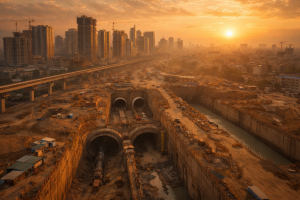
India is building at a scale the world has rarely seen. From metro tunnels beneath Mumbai to smart drainage systems in Pune, a quiet but essential mineral is holding it all together — bentonite. At Elite Mining, we have watched this demand story unfold from our mines in Gujarat’s Kutch district. Here is what the data says, and what it means for the decade ahead.
100+
Smart Cities under
#3
India’s global producer rank
3 MT
India’s annual bentonite output
7.2%
India bentonite CAGR 2026-2036
The Smart Cities Connection
India’s Smart Cities Mission — now expanded to over 100 cities — is not merely about sensors and dashboards. At its core, it is a massive civil engineering programme. Tunnels for metro rail lines, underground utility corridors, new drainage and wastewater networks, and multi-level road projects all demand robust geotechnical materials. Bentonite sits at the heart of this demand.
When engineers bore through urban soil to lay metro tunnels in cities like Ahmedabad, Chennai, or Bengaluru, they rely on bentonite slurry to stabilise the excavation face, lubricate boring equipment, and prevent groundwater ingress. When municipalities build sanitary landfills to manage the waste of growing urban populations, geosynthetic clay liners made with high-swelling sodium bentonite form the critical barrier between waste and groundwater.
“Bentonite is not a glamorous material — but without it, the tunnels would collapse, the groundwater would be compromised, and the foundations would shift. It is the silent guardian of India’s urban infrastructure.
Metro Rail Expansion: A Structural Driver
India currently has operational metro systems in over 20 cities, with dozens more under construction or planning. Every kilometre of underground metro track requires significant quantities of bentonite — used in diaphragm wall construction (also called slurry walls), which stabilise the deep trenches excavated to build station boxes and tunnels.
Slurry wall construction involves filling a trench with a bentonite-water suspension that counteracts earth and water pressure, keeping the excavation stable while reinforcement is placed and concrete is poured. For a single metro station box in saturated urban ground, this can require tens of thousands of litres of bentonite slurry. Multiply this across India’s metro expansion pipeline and the numbers become significant.
Groundwater Containment and Landfill Lining
As India’s urban population grows, so does its waste generation — and with it, the responsibility to prevent contaminated leachate from reaching groundwater. Modern engineered landfills mandated under Solid Waste Management Rules use bentonite-based geosynthetic clay liners (GCLs) as a primary containment barrier.
Sodium bentonite’s extraordinary swelling capacity — it can absorb up to 15 times its dry weight in water — makes it uniquely suited for this task. When hydrated, it forms a near-impermeable gel layer that prevents toxins from migrating into soil and groundwater. In a country of 1.4 billion people generating vast quantities of municipal solid waste, this application alone represents a substantial and growing demand source.
Gujarat: India’s Bentonite Heartland
India produces approximately 3 million tonnes of bentonite annually, ranking third globally after the United States and China. The bulk of this production originates in Gujarat — specifically the Kutch, Bhavnagar, and Amreli districts — where the geology is uniquely suited to high-quality sodium and calcium bentonite deposits.
At Elite Mining, our operations are centred in Kutch, where we manage the full value chain: from exploration and mining to processing, activation, and dispatch. This integrated approach ensures consistent grade quality across our product range, whether for civil engineering, foundry, drilling, or specialty pharmaceutical applications.
Industrial Clusters and Pharmaceutical Demand
Beyond infrastructure, Gujarat’s vast industrial ecosystem — chemical processing zones, ceramic hubs, and pharmaceutical manufacturing clusters — creates consistent, year-round demand for activated bentonite. In pharmaceutical applications, bentonite acts as an excipient, anti-caking agent, and clarifying agent. The Gujarat pharmaceutical corridor, one of India’s most significant, draws on local bentonite supply for both API manufacturing and formulation processes.
Consumer segments such as cat litter — where clumping-grade bentonite is the primary raw material — also add incremental but steadily growing demand as urban pet ownership rises across India’s expanding middle class.
Our Bentonite Application:

Industrial Clusters and Pharmaceutical Demand
Beyond infrastructure, Gujarat’s vast industrial ecosystem — chemical processing zones, ceramic hubs, and pharmaceutical manufacturing clusters — creates consistent, year-round demand for activated bentonite. In pharmaceutical applications, bentonite acts as an excipient, anti-caking agent, and clarifying agent. The Gujarat pharmaceutical corridor, one of India’s most significant, draws on local bentonite supply for both API manufacturing and formulation processes.
Consumer segments such as cat litter — where clumping-grade bentonite is the primary raw material — also add incremental but steadily growing demand as urban pet ownership rises across India’s expanding middle class.
What a 7.2% CAGR Really Means
Industry projections suggest India’s bentonite market will grow at approximately 7.2% compounded annually between 2026 and 2036 — comfortably above the global average of around 5 to 5.5%. This premium growth rate reflects three compounding forces:
Infrastructure scale: India’s construction pipeline — Smart Cities, metro rail, highways, airports, and industrial parks — is among the largest in the world by sheer volume of planned investment. Each of these projects is a bentonite consumer.
Regulatory tightening: Stricter environmental standards for landfill construction and groundwater protection mean that bentonite-based containment systems are no longer optional — they are mandated. This creates a floor of demand that does not fluctuate with economic cycles.
Industrial deepening: As India moves up the value chain in steel, pharmaceuticals, cosmetics, and agri-inputs, demand for specialised bentonite grades — not just commodity volumes — grows proportionally.
“For a business operating at the source of India’s bentonite supply, as Elite Mining does from Kutch, this decade represents not just growth — it represents a structural shift in how the country values what lies beneath its soil.
Elite Mining’s Role in This Story
Established in 2018 and ISO 9001:2015 certified, Elite Mining has grown alongside India’s infrastructure ambitions. Our mine-to-market model — with deposits in Kutch, processing and activation facilities on-site, and a logistics network capable of serving both domestic industrial clusters and global export markets — positions us to meet this demand reliably and at scale.
We supply crude bentonite, activated bentonite, and bentonite powder across all major application grades. Our R&D team tests and approves bentonite grades against each customer’s specific application requirements before full-scale production — ensuring that whether you are building a metro station or blending foundry sand, the bentonite performs exactly as needed.
With 480 satisfied clients across industries and a 24×7 supply commitment backed by secure mine operations, Elite Mining is ready for India’s next decade of building.
Partner With Elite Mining
Sourcing bentonite for infrastructure, drilling, foundry, or specialty applications? Talk to our team about grades, volumes, and logistics.